
Learn about 2 green energy projects that are helping to reduce:
- reliance on diesel generators at off-grid locations; and
- greenhouse gas emissions from Government of Yukon buildings.
Biomass
We upgraded the biomass heating system at Elijah Smith Elementary School. This system, which is fueled by wood pellets, was fully operational at the beginning of the 2023-24 school year. After 2 winters of operation, it has provided 75 per cent of the school’s heating energy.
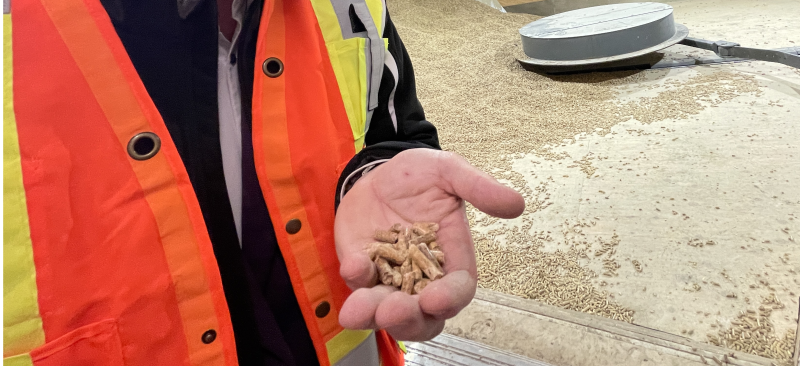
Wood pellets fuel the Elijah Smith Elementary School biomass system.
Combined with a building envelope retrofit that upgraded the building’s roof, vapour barrier and insulation, which was completed in 2022, the upgrades have reduced the school’s propane consumption by a total of 80 per cent.
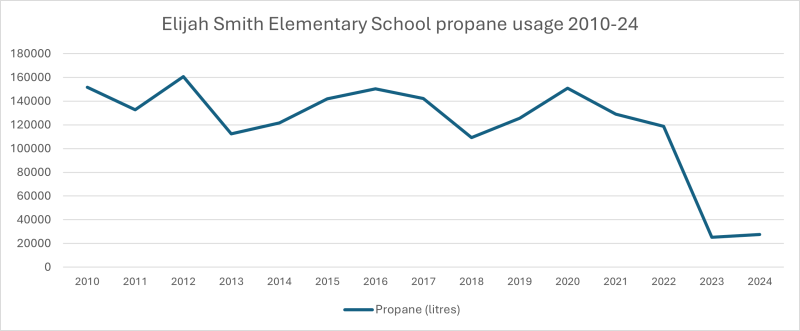
Since the biomass system began heating the school at the start of the 2023-24 school year, the school’s propane usage has declined. This helps reduce the greenhouse gas emissions created by the propane heating system.
Solar
We’ve installed a solar array and battery energy storage system at the Ogilvie highway maintenance camp. By combining solar generation and battery storage, we aim to minimize diesel generation at this site in favour of solar generation. This system features a:
- 221 kilowatt (kW) solar array; and
- 500-kWh battery storage unit.
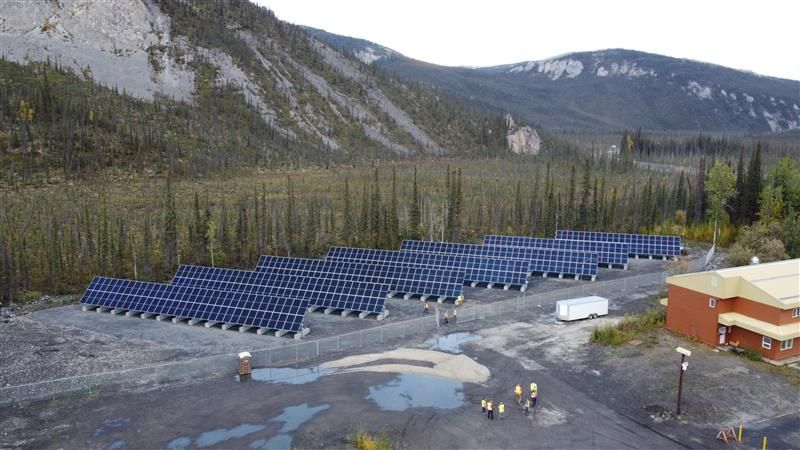
The Ogilvie solar array under the summer sun.
Since its completion in October 2024, the solar array has:
- provided 29 per cent of the site’s electrical energy; and
- offset roughly 17,500 litres of diesel fuel.
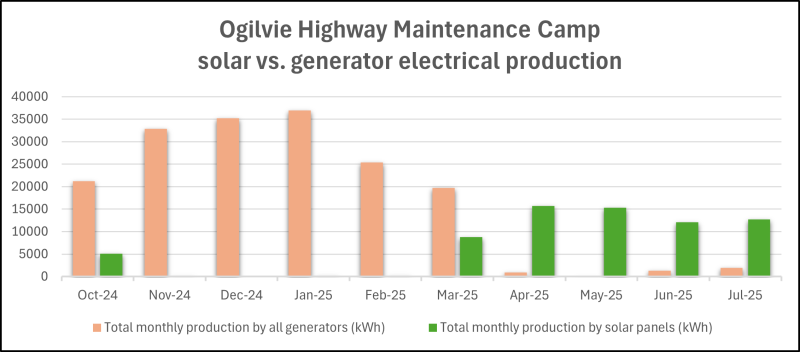
At high latitudes on the Dempster Highway, the shift from long winter nights to long summer days is abrupt. In February 2025, the camp used 99 per cent diesel electricity, and by April, the camp was using 95 per cent solar electricity.
In summer 2025, the Ogilvie maintenance camp system met or exceeded projections. Only a few cloudy periods required diesel generation. We expect the offset to continue to rise through late summer and early fall 2025 as the solar array continues to meet the site’s electrical demand. We estimate that the annual solar contribution will exceed 40 per cent.
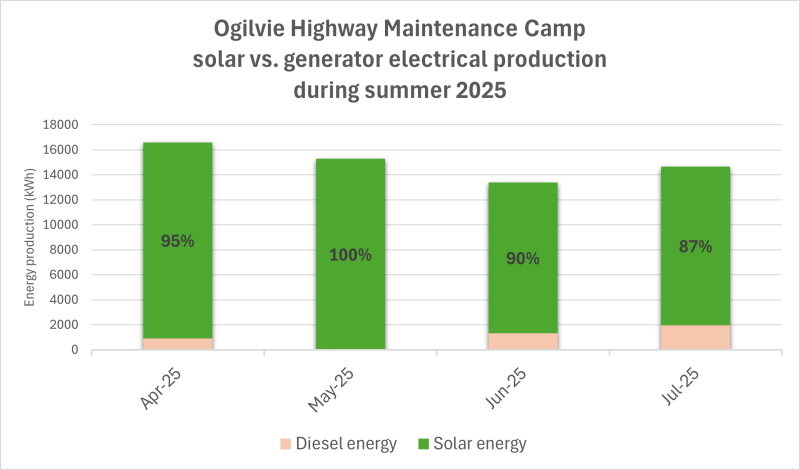
The site used 93 per cent solar energy in April to July 2025. There will always be some diesel used. We test the generators monthly to make sure they’re ready to run when needed.
Why this matters
Many existing buildings can be improved to:
- use less energy;
- increase local energy production and reduce energy imports; and
- be more resilient to climate change.
The energy efficiency of our homes and buildings is affected by:
- insulation;
- air-tightness; and
- heat and power systems.
It’s important to increase the amount of electricity we produce from renewable sources. While most of our on-grid electricity currently comes from renewable sources, such as hydro-electricity, we also have off-grid sites that rely on diesel generators. That’s where other renewable energy sources can make the biggest impact.