
Environmental monitoring
Find the latest information on the environmental monitoring of the Victoria Gold Corporation's heap leach failure.
For details on news, human health effects, mining, support or to go back to the home page follow the links provided:
Fish monitoring
Technical experts with the Government of Yukon and the First Nation of Nacho Nyak Dun developed a long-term fish monitoring program to measure changes over time in the area.
The fish monitoring program involves:
- Assessing fish at approximately 50 locations throughout the Haggart Creek watershed, including:
- unimpacted (control) sites within tributaries that drain into Haggart Creek.
- Potentially impacted sites within Haggart Creek, Dublin Gulch and the South McQuesten River.
- Taking samples from fish to assess for heavy metal concentrations and signs of tissue damage.
- Determining fish population abundance, to allow for detection of measurable changes over time, due to habitat changes like sediment load or contamination from the mine.
- Monitoring Arctic grayling movement throughout the Haggart Creek watershed.
Over the summer of 2024, this joint program completed work which included:
- Sampling for population abundance and fish habitat at 44 locations (15 potentially impacted locations and 29 control locations).
- Collecting tissue samples from Arctic grayling and slimy sculpin, which are being analysed for heavy metal contamination, including arsenic, cadmium, lead and mercury.
This sampling work will help us form a baseline for these populations and bioaccumulating metals. Bioaccumulation is the gradual accumulation of substances, such as pesticides or other chemicals, which can occur in fish, wildlife and other species.
Read the Haggart Creek Watershed 2024 Fisheries Monitoring Program full report and summary.
In 2025, this technical group is replicating the 2024 program to assess whether fish populations within this watershed have been affected by the heap leach failure. In addition to replicating last year’s efforts, the joint program is also installing multiple receiver arrays to detect Arctic grayling that were tagged in 2024. This data will improve our understanding of their migration and movement throughout the watershed.
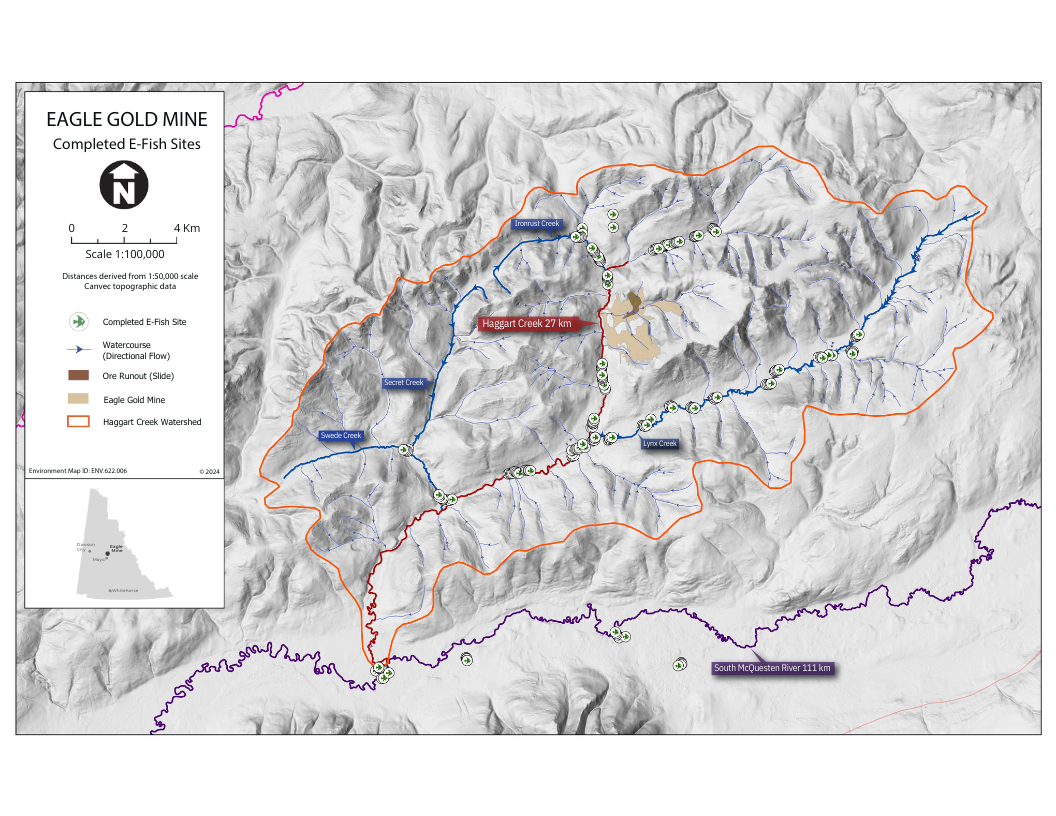
Eagle Gold fish monitoring map
This map shows all control (state) and impact sites around the Eagle Gold Mine site where fish samples are being collected.
Water monitoring
Eagle Gold water sampling
The Government of Yukon samples and monitors water quality downstream of the Eagle Gold Mine. Water samples are collected daily at select sites.
Water samples are tested for cyanide, metals and other contaminants.
Water sample results are compared to water quality objectives in the mine’s licences and to aquatic health guidelines in:
- the Canadian Council of the Ministers of the Environment’s Canadian Environmental Quality Guidelines; and
- BC’s Approved Water Quality Guidelines.
Cyanide sample results
Cyanide samples show results for five types of cyanide. Results are compared to the chronic aquatic health guideline of 0.005 mg/L. If a result is less than 0.005 mg/L it is not high enough to harm aquatic health in the area. If the result reads ‘ND’ it means ‘non-detect’. ‘Non-detect’ means the amount of cyanide is too small to be measured.
Water samples are tested for the following types of cyanide:
- strong acid dissociable (SAD) cyanide;
- weak acid dissociable (WAD) cyanide;
- free cyanide;
- thiocyanate; and
- cyanate.
Metals and other parameters
Metal results are highlighted if samples exceed downstream water quality objectives. We test for the following:
Total metals
- Antimony;
- arsenic;
- cadmium;
- cobalt;
- copper;
- iron;
- mercury;
- manganese;
- molybdenum;
- nickel;
- lead;
- selenium;
- silver;
- uranium; and
- zinc.
Dissolved metals
- Aluminum
Other contaminants
- Chloride;
- sulphate;
- ammonia;
- nitrate; and
- nitrite.
Eagle Gold water sample results
Water sample results from samples collected following the heap leach failure are published on this webpage.
Ammonia results
View the complete history of ammonia results to date.
Arsenic results
View the complete history of arsenic results to date.
Copper results
View the complete history of copper results to date.
Cobalt results
View the complete history of cobalt results to date.
Cyanide results
View the complete history of cyanide results to date.
Mercury results
View the complete history of mercury results to date.
Nitrite results
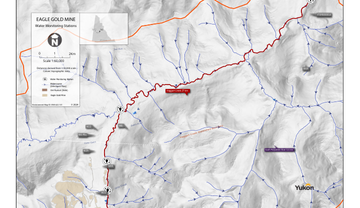
Eagle Gold surface water sample location map
This map shows the impact area around the Eagle Gold Mine site where water samples are being collected from surface water.
Wildlife monitoring
Moose and caribou monitoring
In the fall and winter of 2024-25, the Department of Environment worked with the First Nation of Na-Cho Nyäk Dun and local harvesters to begin monitoring a suite of element and metal levels in wildlife near the mine.
Contaminants can build up in wildlife tissues over time and reach levels that pose risks to human health if consumed. We need to monitor wildlife in the area to understand any long-term effects from the heap leach failure. We analyzed samples collected during the 2024-25 harvest season to provide baseline data for wildlife in the area. We’ll compare the contaminant levels in future samples to these baseline data.
Results
Results from the 2024-25 harvest season show that the concentrations of metals and elements in moose, caribou and furbearers were below toxic levels. At this time, in consultation with the Chief Medical Officer of Health, there is no indication that current harvesting of wildlife for consumption poses a health risk.
Find the 2024-25 contamination monitoring results.
The Department of Environment’s Animal Health Unit and the First Nation of Na-Cho Nyäk Dun continue to ask hunters harvesting moose and caribou north of Mayo to collect samples of:
- liver;
- kidney;
- muscle; and
- incisor bar.
We’re looking for samples from the following Game Management Subzones:
- 2-53
- 2-56
- 2-58
- 2-59
- 2-60
- 2-61
- 2-62
- 2-63
Hunters will not receive results on their individual submissions. The continued testing of samples over several years will help us determine if the levels of heavy metals in caribou and moose tissues change over time.
Hunters can pick up sampling kits at Environment district offices in:
- Mayo;
- Dawson; and
- Whitehorse.
Sampling kits can also be picked up from the First Nation of Na-Cho Nyäk Dun Lands office in Mayo.
The Government of Yukon is offering hunters their choice of meat bags or a thermos as a token of appreciation for participation in this voluntary program.
Email [email protected] or phone 867-667-5600 if you have questions or concerns.
Contact information
Department of Energy, Mines and Resources: [email protected]
Department of Environment: [email protected]
Employment Standards Office: [email protected] or 867-667-5944
Environmental Health Services: [email protected] or 867-667-8391
Workers’ Safety and Compensation Board - [email protected] or 867-667-5645
Contact PricewaterhouseCoopers
PricewaterhouseCoopers: Send an inquiry